.webp) pixelburstgame.com
pixelburstgame.comHow to Manage Staff, Cleaning, and Repairs Efficiently in Waterpark Simulator
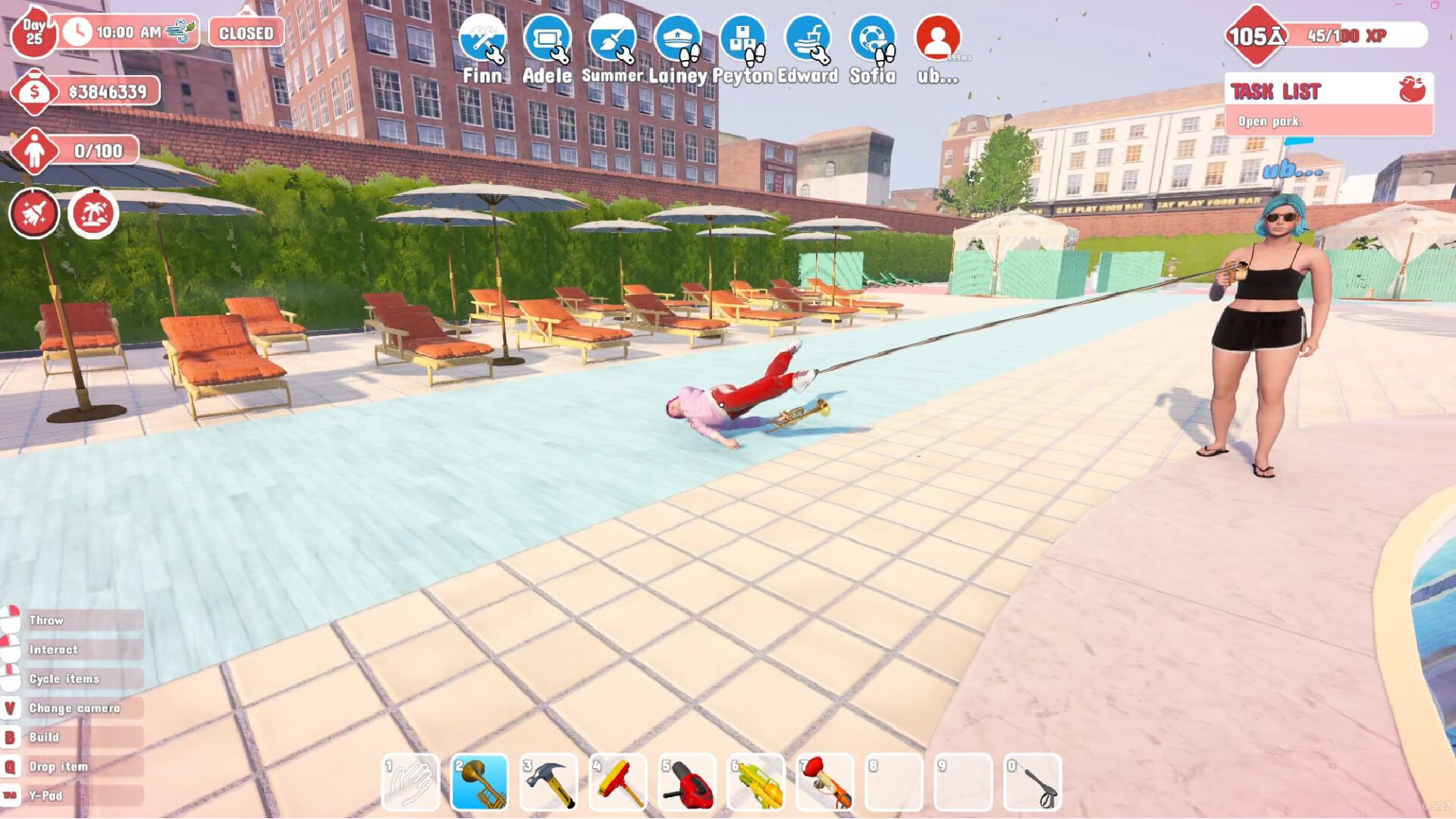
Waterpark Simulator is not only about constructing exciting slides and attracting visitors. Once the park becomes busy, one of the hardest challenges is keeping the entire operation functioning while guests continue moving between attractions, food areas, pools, and other facilities. Cleaning, repairs, safety, rescues, and staff movement can quickly become interconnected problems. A park that looks successful from a construction perspective can become inefficient when employees spend too much time walking, dirty areas remain unattended, or broken attractions stay unavailable for too long.
This makes staff management one of the most important “how to” problems in Waterpark Simulator. The key is not simply hiring as many employees as possible. More staff can help, but only when they are supported by an efficient park layout and sensible task distribution. If the park is poorly organized, additional workers may spend much of their time traveling instead of actually cleaning, repairing, or servicing guests.
The best approach is to build the park around operational efficiency from the beginning. Every attraction creates work. Every food facility creates work. Every busy walkway creates cleaning requirements. Every large expansion increases the distance employees may need to travel. Understanding this relationship allows you to predict problems before they become serious.
This guide focuses specifically on how to build a staff-management system that can continue working as the waterpark becomes larger. The progression follows the natural development of a park, starting with the first employees and ending with a larger operation where cleaning, maintenance, safety, and guest services must work together.
How to Plan Staff Requirements Before the Park Gets Busy
The first step in staff management is understanding that employees should be added according to workload rather than park size alone. A small park with several busy attractions can create more work than a larger park with relatively few active facilities. The number of structures is therefore not enough to determine how many workers you need.
At the beginning of a new park, the priority should be learning how quickly tasks accumulate. Watch how often attractions require attention, how quickly guests create trash or other cleanliness problems, and how much time employees spend traveling between locations. This gives you a better indication of the park's real workload.
Hiring too early can create unnecessary expenses, while hiring too late can allow small operational problems to become major guest-satisfaction issues. The ideal approach is to add employees when you can identify a specific workload that the current team can no longer handle efficiently.
Before hiring another worker, check:
- Are existing employees constantly occupied?
- Are cleaning tasks remaining unattended?
- Are broken attractions staying unavailable for too long?
- Are guests waiting because a service area is understaffed?
- Are employees spending excessive time walking?
- Is one operational area generating most of the workload?
These questions help distinguish a genuine staffing shortage from a layout problem.
If employees are working continuously but completing tasks efficiently, the staffing level may be appropriate. If employees spend most of their time traveling across the park, hiring more workers may only partially solve the problem.
How to Divide the Park Into Practical Work Zones
One of the most effective ways to improve staff efficiency is to divide the park into zones. Instead of thinking of the entire waterpark as one large operational area, treat different sections as smaller work environments.
A pool and slide area may generate frequent cleaning and safety requirements. A food area may generate trash and customer-service tasks. A quieter decorative area may require much less attention. If these areas are scattered without a clear structure, employees may constantly move from one side of the park to the other.
Zoning reduces unnecessary travel.
A practical park can be divided into areas such as:
- Main entrance and guest services.
- Large slide and attraction zone.
- Pool and relaxation zone.
- Food and seating zone.
- Maintenance-heavy attraction zone.
- Decorative or low-traffic zone.
The zones do not need to be perfectly separated. Their purpose is simply to help you understand where work is being generated.
<h3>Match staff coverage to workload</h3>
A busy attraction area should receive more attention than a quiet corner. If most guests spend their time around the main pool and slides, that area should naturally receive more operational support.
This is especially useful when the park begins expanding. Instead of asking, “How many employees does my park need?” ask, “Which zone is generating the most work?”
That question produces a much more useful answer.
<h4>Why zoning becomes more important later</h4>
As the park expands, distances increase. An employee who could easily manage the entire park during the early game may struggle once several new attractions are added.
Zoning allows the player to scale operations gradually instead of completely rebuilding the staffing structure every time the park expands.
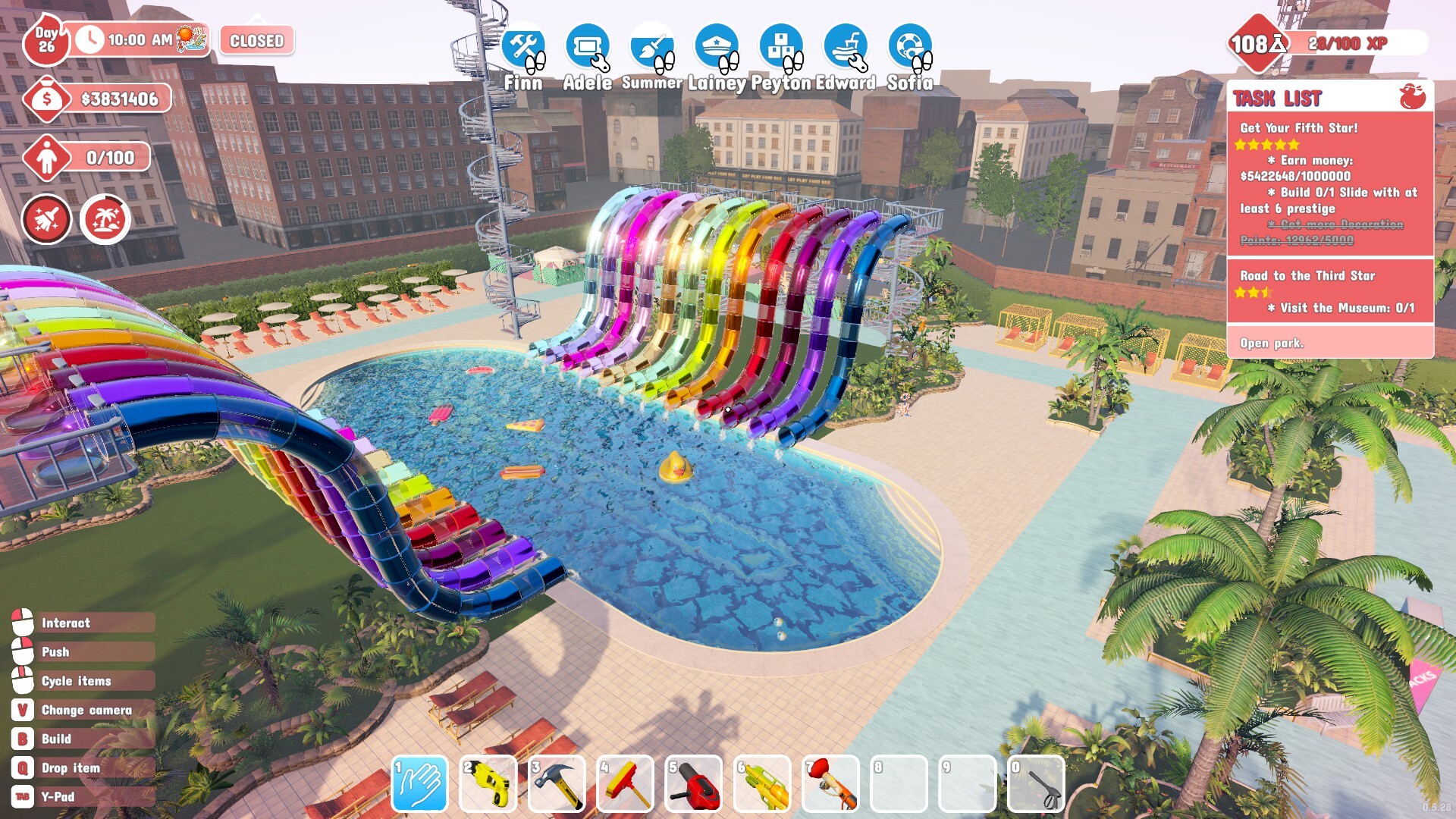
How to Reduce Cleaning Problems Before They Become Serious
Cleaning is one of the easiest areas to underestimate because a park can look perfectly manageable when guest numbers are low. As visitor activity increases, however, waste and other cleanliness problems can accumulate faster than expected.
The most effective cleaning strategy is prevention through layout.
If a large number of guests repeatedly pass through one narrow area, that area will naturally become more demanding. Food facilities can also create concentrated cleaning requirements because guests gather, consume items, and remain in the same area for longer periods.
Instead of placing food facilities wherever there is empty space, create a dedicated food zone with enough room for guests to queue and move around.
This makes cleaning easier because the workload is concentrated in a predictable location.
<h3>Identify recurring dirty areas</h3>
Do not simply clean whatever area happens to look dirty at the moment. Watch for patterns.
If the same walkway repeatedly requires attention, determine why. If one food area is constantly messy, determine whether the problem comes from excessive guest concentration. If a particular attraction produces frequent cleaning work, consider whether the surrounding layout is too compact.
A recurring dirty area is useful information.
It tells you where guest activity is concentrated.
<h4>Build cleaning routes around guest activity</h4>
The most efficient cleaning coverage follows the guest journey rather than the visual appearance of the park.
High-traffic areas deserve frequent attention.
Medium-traffic areas can be checked less often.
Low-traffic decorative areas generally should not receive the same level of attention as the central attractions.
This approach prevents employees from spending too much time maintaining areas that have little effect on the guest experience.
How to Manage Food Areas Without Creating a Staff Bottleneck
Food facilities are useful because they support guest needs, but they also create another operational workload. Guests gather around them, queues form, waste accumulates, and employees may need to service the area.
The biggest mistake is placing multiple food facilities directly on the main pedestrian route.
When a queue expands, it can block visitors who are simply trying to reach another attraction. This creates additional congestion and can also make it more difficult for staff to access the food area.
Instead, create a service zone slightly away from the main route.
The structure should allow guests to leave the main path, visit the food area, and return to the main circulation route without forcing everyone else through the same space.
A simple arrangement can be:
Main walkway → food entrance → food facilities → seating → exit back to walkway.
This structure contains guest activity.
<h3>Keep staff access in mind</h3>
Food areas should also be accessible to employees. If the area is surrounded by queues, decorations, or attractions, staff may struggle to reach the facilities they need to service.
Leave enough open space around the food zone for operational movement.
This is particularly important once the park becomes crowded.
<h4>Do not overbuild food services too early</h4>
Adding more food facilities can seem like an easy way to increase guest satisfaction, but every new facility can create additional operational requirements.
Expand food services when demand justifies them.
A smaller, well-managed food zone is generally easier to control than several scattered facilities that each require attention.
How to Handle Broken Attractions Efficiently
Repairs become increasingly important as the park develops. A broken attraction is not just a technical problem. It can affect guest movement because visitors who expected to use that attraction may redirect themselves toward other areas.
This can unexpectedly increase traffic elsewhere.
Imagine that one popular slide becomes unavailable. Guests who would normally queue there may suddenly move toward another attraction. That second attraction can become overcrowded, while the first attraction remains inactive.
A repair problem can therefore become a traffic problem.
The first priority should be identifying which broken attraction has the greatest effect on the park.
A useful repair priority is:
- Popular attractions with large guest demand.
- Attractions located in major circulation areas.
- Facilities whose closure causes guests to crowd another attraction.
- Less important attractions that have limited visitor demand.
Do not only look at the broken attraction itself.
Watch where its customers go.
If the closure causes a neighboring attraction to become overloaded, repairing the original attraction may solve two problems simultaneously.
This is one reason operational management should always be connected to guest-flow observation.
When designing the park, avoid surrounding major attractions with unnecessary obstacles. Employees need to reach facilities quickly, and guests need space to move around them.
A beautiful attraction surrounded by decorative objects may look impressive, but if those objects interfere with access, they can reduce operational efficiency.
Function should come before decoration around maintenance-heavy facilities.
How to Manage Safety and Rescue Work as the Park Expands
Safety becomes more complicated as the number of attractions and guests increases. A larger park naturally contains more opportunities for operational incidents, which means safety-related tasks need to be considered when planning the layout.
One of the most useful strategies is to avoid placing every high-risk or high-traffic attraction in one extremely crowded location.
Concentrating attractions can make the park visually impressive and convenient for guests, but it can also create a single area where many operational requirements overlap.
If that area becomes overwhelmed, multiple problems can appear at once.
For example:
- Large guest crowds increase movement.
- Increased movement creates more cleaning requirements.
- Queues occupy walkways.
- Staff have difficulty reaching the area.
- Safety-related tasks become harder to handle.
- Guests begin moving around obstacles and creating additional congestion.
A more balanced layout distributes activity across the park.
Major operational routes should not be blocked by queues, decorations, or unnecessary structures.
The goal is not to create an empty park.
The goal is to create enough space that employees can reach the areas where they are needed.
Even if an area normally works well, consider what happens when something goes wrong.
A park should have enough space to absorb unusual situations.
If one attraction suddenly creates a large crowd, can guests move around it?
If staff need to reach that attraction, can they approach it without crossing a huge queue?
If the answer is no, the layout may need to be redesigned before the park becomes even larger.
How to Prevent Staff From Walking Too Far
One of the most common operational inefficiencies in a large park is unnecessary walking.
An employee may technically be completing every assigned task, but if they constantly travel from one end of the park to another, their effective productivity becomes much lower.
The solution is not always to hire more employees.
First, inspect the distance between work locations.
If one worker is responsible for several facilities that are spread across the entire park, reorganize the area if possible.
A simple zoning structure can significantly reduce travel.
Facilities that generate similar work should be relatively close together.
Food facilities can share a service area.
High-maintenance attractions can occupy one section.
Pools and nearby water-related facilities can be organized together.
Decorative areas can be placed farther away from the busiest operational zones.
This does not mean every park needs identical zoning. The principle is simply to reduce unnecessary movement.
Ten employees are not automatically better than five.
If five employees can efficiently handle the park because their routes are short, adding five more may provide little benefit.
Conversely, a larger staff can still struggle if the park forces them to travel excessive distances.
Always consider:
Staff count + workload + travel distance.
Those three variables determine practical efficiency.
How to Expand Without Destroying Your Existing Staff System
Expansion is where many early staffing decisions begin to fail.
A park can operate perfectly at a small scale, but adding a new section can dramatically increase walking distances. The player may then notice that cleaning takes longer, repairs take longer, and staff appear increasingly overwhelmed.
This does not necessarily mean the original staff system was wrong.
The park has changed.
When adding a major new section, treat it as a new operational zone.
Ask:
What activities happen here?
How many guests will use them?
What type of maintenance will they generate?
How far is this zone from the existing staff coverage?
Will existing employees need to cross the entire park to reach it?
If the new area creates substantial additional work, consider adding dedicated staffing rather than stretching the existing team across an increasingly large map.
Instead of building a massive new section all at once, expand gradually.
First add the major attraction.
Then observe guest behavior.
Then add supporting services.
Then evaluate cleaning and maintenance.
Finally add decorative elements.
This makes it much easier to identify which addition created a new workload.
Empty space has operational value.
It allows you to move facilities later when traffic patterns become clearer.
A flexible park is easier to manage than a completely packed park.
How to Diagnose a Park That Suddenly Becomes Inefficient
Sometimes a park can appear to work perfectly and then suddenly develop several problems at once. Guests become unhappy, attractions remain dirty, employees seem overwhelmed, and queues become longer.
When this happens, do not immediately rebuild everything.
Find the first point of failure.
Start by observing guest movement.
Where is the largest crowd?
Then inspect the nearby attraction.
Is its queue blocking traffic?
Next, look at staff movement.
Are employees spending too much time traveling?
Then inspect cleanliness and repairs.
Are the problems concentrated in the same area?
If several problems occur in one location, the layout is probably contributing to them.
A useful diagnostic sequence is:
- Find the largest guest crowd.
- Identify the attraction or service generating it.
- Check whether its queue blocks another route.
- Observe where employees travel.
- Identify recurring cleaning or repair tasks.
- Determine whether one redesign could solve multiple problems.
- Change one major part of the layout.
- Observe the park again.
Suppose guests are unhappy because a food area is overcrowded.
Adding another employee may improve service temporarily.
Adding another food facility may increase capacity.
But if the food area is positioned on the only major walkway, the underlying traffic problem remains.
Moving the food zone away from the main route may solve the queue problem, improve guest movement, and give staff easier access simultaneously.
That is a much more efficient solution.
If you completely redesign the park after every problem, you will have difficulty identifying which change actually worked.
Make targeted changes.
Observe.
Then make the next adjustment.
This turns park management into a controlled optimization process.
How to Build a Long-Term Staff System for a Large Waterpark
Once the park becomes large, staff management should stop being reactive. Instead of waiting for a problem and then hiring someone, establish a predictable operational structure.
The park should have clearly identifiable high-workload zones, reasonable employee travel distances, and enough spare capacity to handle temporary increases in activity.
The goal is not to operate at maximum staff utilization every minute.
A small amount of spare capacity is useful.
If every employee is already occupied when the park is operating normally, one broken attraction or sudden increase in guests can overwhelm the system.
A better structure is to maintain enough flexibility that temporary problems can be absorbed without immediately creating a chain reaction.
The long-term staffing system should consider four major areas:
Cleaning keeps the park visually and functionally maintained.
Repairs keep attractions available.
Safety protects guests and allows incidents to be handled.
Guest services keep visitors supplied and satisfied.
These systems interact.
A broken attraction can redirect guests.
Redirected guests can create congestion.
Congestion can increase cleaning requirements.
Cleaning and repairs can then require more staff movement.
The most efficient park anticipates these connections.
Every major expansion should trigger a review.
Ask whether:
- Existing employees still cover the park efficiently.
- New attractions create additional maintenance work.
- Guest routes have become longer.
- Food areas are becoming crowded.
- Cleaning workload has increased.
- Repair response is becoming slower.
- Staff travel distances have become excessive.
If several answers are yes, the park is ready for a staffing adjustment.
The best long-term strategy is therefore not simply “hire more workers.”
It is:
Design better → observe workload → zone operations → hire when necessary → expand → reassess.
Conclusion
Managing staff efficiently in Waterpark Simulator requires more than watching how many employees you currently have. The real challenge is understanding how the physical design of the park determines the amount of work those employees must perform.
Every new attraction creates operational consequences. A busy slide produces queues and guest movement. A food facility creates a concentrated service area. A large pool can create additional cleaning and safety requirements. A broken attraction can redirect visitors toward another part of the park. Expansion increases the distance employees must travel.
These systems are connected.
The most efficient approach is therefore to design the park around operational zones. Keep related facilities reasonably close together, prevent queues from blocking major paths, provide staff with practical access to high-workload areas, and avoid filling every available space with attractions or decorations.
Cleaning should be managed according to guest activity rather than random locations. Repairs should be prioritized according to how strongly a broken facility affects the rest of the park. Safety areas should retain enough open space for staff movement. Food services should be organized so their queues do not become transportation barriers.
Most importantly, do not automatically solve every problem by hiring more staff. If employees are spending too much time walking, the layout may be the real problem. If one area repeatedly becomes dirty, investigate why guests are concentrating there. If a queue blocks the main path, move the queue or attraction rather than simply increasing staffing.
As the park expands, review the entire operational structure. A staffing plan that works for a small waterpark may not remain efficient when the park doubles in size. Treat every major expansion as an opportunity to evaluate workload, travel distance, guest flow, and service coverage.
The strongest Waterpark Simulator parks are not necessarily the ones with the most employees or the largest number of attractions. They are the parks where every system supports the others. Guests can move naturally, employees can reach their tasks quickly, attractions remain available, food areas stay manageable, and problems can be solved before they spread.
Once you learn to manage staff according to workload, distance, zoning, and guest behavior, expansion becomes much easier. Instead of constantly reacting to problems, you begin designing the park so that fewer problems appear in the first place.